Healthcare Insights
The Audience Discovery and Analytics Evolution
Our new Director of Analytics, Richard Page, and I have recently been discussing the rapid shifts in audience discovery i.e. how audiences search for and consume information online, and what this means for anyone in an insights, marketing or comms role today.
We wanted to share our perspective on what that shift means for pharma. We think it’s a handy way to look at this through a PESO lens (i.e. in relation to paid, earned, shared and owned media).
For example, third-party communications (earned media) shape trust, AI visibility and sentiment towards a brand. Social platforms increasingly influence what audiences see, even when they are actively searching for information. Owned content is becoming important less as a destination in its own right, and more as a source of content for search, social and AI systems.
GenAI and large language models source information from across this wider ecosystem, so our analytics need to be integrated too. We need to understand how each modality is performing, and how they work together to shape visibility, influence and action.
“Central to our approach is the integration of primary market research with social and search analytics, and other forms of secondary data including, where relevant, commercial and behavioural data. This helps us build a more holistic picture of audiences, behaviours and market dynamics.”
Richard
How people find their information and encounter brands is shifting
One of the clearest shifts we see is how audience discovery is moving from a world of ‘searching and following’ to one increasingly shaped by ‘AI answers and algorithms.’
This matters for healthcare brands because AI systems and recommendation algorithms are influencing what audiences see. Search is increasingly mediated by AI-generated summaries and AI answer layers. Google AI Overviews have reached major scale, with 1.5bn+ monthly users in 2025. AI search prompts are becoming longer and more conversational than traditional search, while AI-curated summaries can reduce click-throughs to traditional sources.
At the same time, social discovery is increasingly shaped by platform algorithms. YouTube processes 80bn+ signals daily for recommendations, while Meta feed ranking uses thousands of ranking signals to shape what appears in feeds. A similar shift is playing out across TikTok, Reddit, X and LinkedIn.
This means pharma brands need to understand how AI and algorithms shape discovery, visibility and influence, not just how individual channels perform in isolation.
Digital analytics provides a mirror to real-world behaviour
When we talk about social and digital analytics, this includes analysing unprompted online conversations and search behaviours to understand opinions, emerging trends and market dynamics at scale.
‘’Analytics provides a mirror to real-world behaviour around health by observing what people do online. It helps brands understand what people search for, say, share and engage with, alongside what they report when asked.’’
Richard
These behaviours now play out across multiple channels, platforms and touchpoints, which means no single research method or data source can provide the full picture. The most useful insight comes from an integrated research approach that connects different forms of evidence and interprets them together.
A connected data ecosystem creates holistic insight
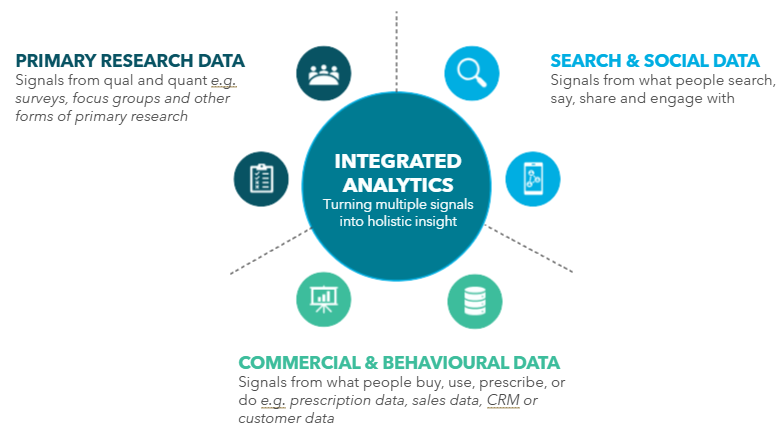
Different client questions require different evidence combinations.
Primary market research remains central for understanding attitudes, motivations, needs and decision-making. Social and search analytics add broader category, cultural and behavioural context beyond the respondent. Analytics may also involve layering in additional data lenses (e.g. commercial) to add further depth.
‘’The important point is that the data ecosystem should be designed around the question we are trying to answer. By being smart about the data available, the role each source can play and the budget we are working with, we can create an approach that is both focused and holistic.’’
Karen
Analytics drives decisions across the lifecycle
Our insights work supports decisions across the full brand lifecycle, but our particular area of analytics expertise is audience and activation intelligence
→ Audience intelligence: enriching segmentation and personas with real-world behaviour
Audience intelligence helps us understand who matters, what drives them and how they make decisions. Traditional primary market research is powerful for identifying the attitudes, needs and motivations that audiences naturally cluster around. By integrating this with social and search analytics, we can add a richer view of the behaviours audiences exhibit online.
This helps translate stated attitudes into real-world behaviours: what audiences search for, the questions they ask, the language they use, the content they respond to and the information sources they engage with. For pharma teams, this creates a more rounded view of audiences and helps enrich segmentation, personas and journey understanding.
→ Activation intelligence: using real-world language to sharpen messaging and content
Activation intelligence is about using analytics to translate audience understanding into sharper claims, messaging, content and channel strategy.
This has been particularly valuable in claims and messaging research. Quantitative research can show which messages perform strongest, while social and search analytics can help explain the real-world language, questions and themes audiences naturally use around a topic.
The result is more actionable insight: messaging and content recommendations that are grounded not only in what audiences say in research, but also in how they search, talk and engage in the real world.
Ultimately, we believe that integrated analytics helps pharma teams move from isolated data points to clearer decisions: who to prioritise, what to say, where to show up and how to optimise over time.

Karen Douglas
Commerical Director,
Healthcare Europe
If you're exploring new ways to decode real-world patient behaviour, we’d love to connect!
Healthcare Europe:
Karen Douglas, Commercial Director
kdouglas@buzzback.com
Healthcare US:
Jonathan Weiser,
Healthcare Practice Lead
jweiser@buzzback.com