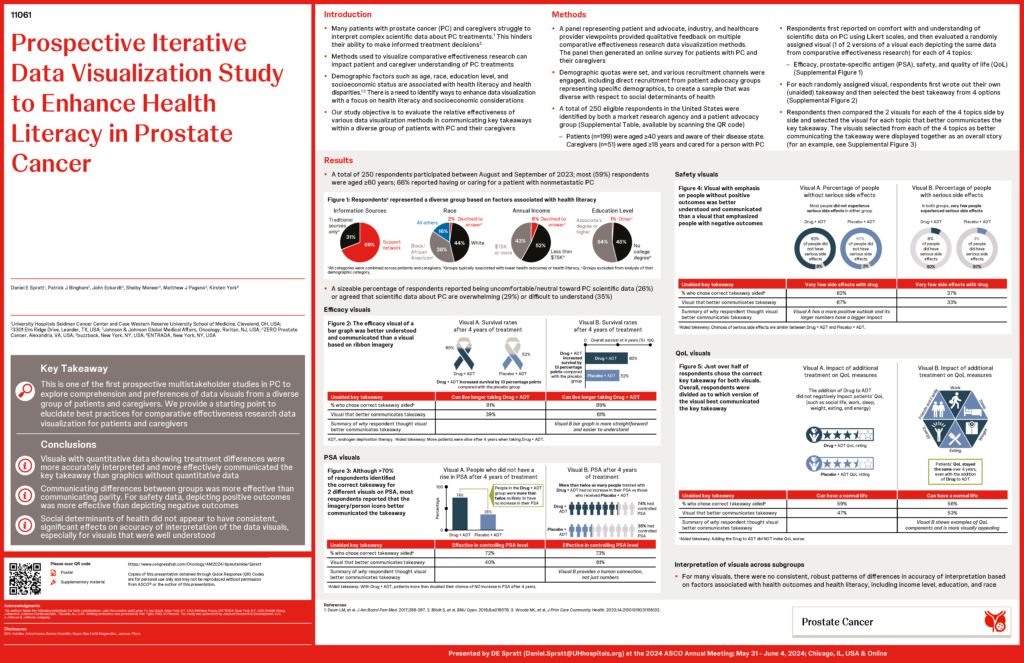
To make informed treatment decisions, it is important that patients and caregivers understand the (often) complex data shown to them. But how do you present complex scientific data in a way that is easy to understand?
With that question in mind, Johnson & Johnson Innovative Medicine partnered with ZERO Prostate Cancer — a patient advocacy group and their membership, buzzback and ENTRADA to understand how to improve the ways scientific data are presented.1 With special attention to health literacy and socioeconomic consideration, the goal was to create easily interpretable visualizations comparing their drug to a placebo across four different categories of patient outcomes (efficacy, prostate-specific antigen (PSA) level, safety and quality of life).
The research, presented at the American Society of Clinical Oncology (ASCO) Annual Meeting in June of 2024, is summarized below, with the full poster at the bottom of this blog. While the research was based on prostate cancer, the findings on visualization can be applied much more broadly — to other health conditions and beyond the healthcare industry.
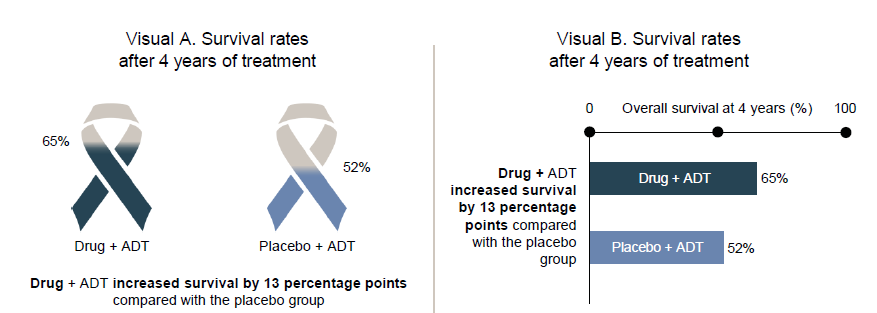
Efficacy Visuals
Research found that a bar graph (Visual B) is considered more straightforward, and thus communicated better and is more easily understood than a visual based on ribbon imagery (Visual A).
PSA Visuals
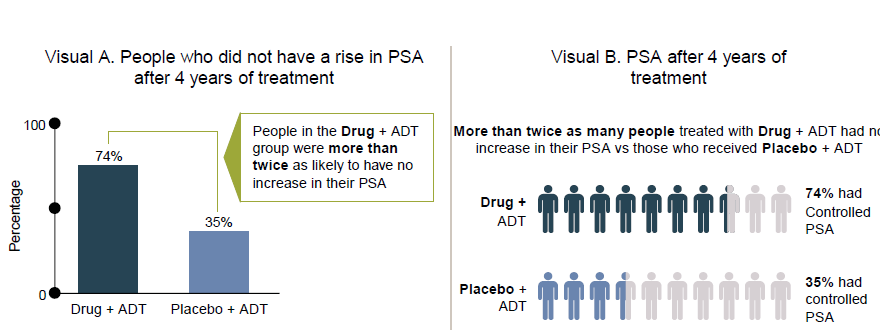
Although >70% of respondents identified the correct takeaway for 2 different visuals on PSA, most respondents reported that the imagery/person icons (Visual B) better communicated the takeaway, due largely to its human connection. Patients and caregivers found that Visual B “humanizes the disease,” “makes it more personal,” and shows “people instead of statistics.”
Safety Visuals
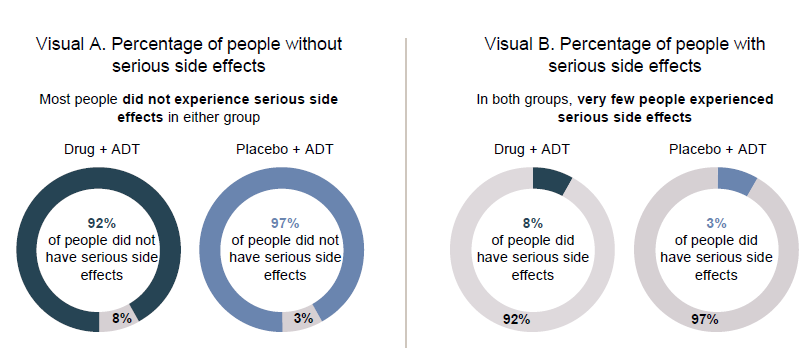
A visual with emphasis on people without serious side effects (Visual A) has a more positive outlook and larger numbers with bigger impact, and thus was better understood than a visual with emphasis on people with serious side effects (Visual B).
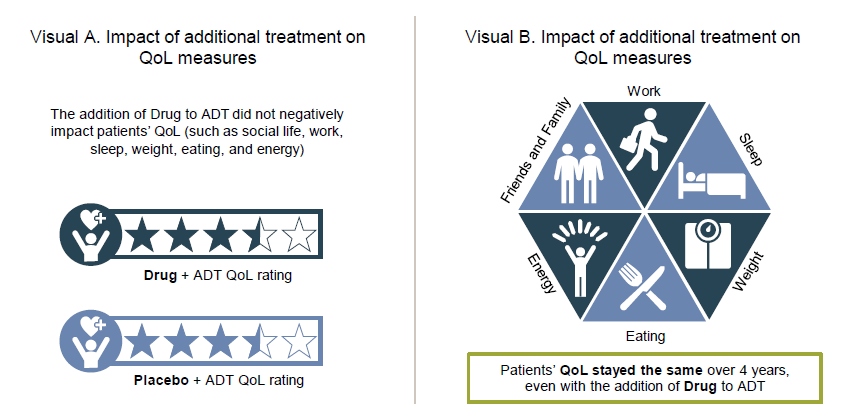
Quality of Life Visuals
Only slightly more than half of respondents identified the correct key takeaway for either visual. Overall, respondents were divided as to which version of the visual best communicated the key takeaway, suggesting that neither version is significantly easier to understand than the other.
Conclusions
- Visuals with quantitative data showing treatment differences are more accurately interpreted and more effectively communicate the key takeaway than graphics without quantitative data.
- Communicating differences between groups is more effective than communicating parity. For safety data, depicting positive outcomes (incidence of no serious side effects) is more effective than depicting negative outcomes (incidence of serious side effects).
- Social determinants of health do not appear to have consistent, significant effects on accuracy of interpreting the data visuals, especially for visuals that are well understood overall.