Ten years ago, when we first explored Gen Z's relationship with technology, the questions were largely about access: what young people were using, when they were using it, and why. Technology helped them access information, entertainment, friends, and products; when they no longer needed that access, the device could, at least in theory, be put down.
Today, technology is doing something much broader. Phones organize daily life, social media shapes identity, gaming creates spaces for connection and achievement, and AI helps people research, create, and decide. The biggest change is not simply what technology can do, but what Gen Z asks it to do — and sometimes needs it to do — as they navigate relationships, emotions, choices, and uncertainty.

If you're looking for fresh ways to understand what people think, feel, and do, we'd love to connect!
Kristen Harmeling, VP Research
kharmeling@buzzback.com
Technology is part of a high-pressure environment
To best understand Gen Z's relationship with technology, we need to understand the context in which it lives. In buzzback's recent US and UK research, we found that young people are carrying more stress and pressure than their older peers.
The data remains elevated among 19–22-year-olds and then decreases among older Gen Z's and younger Millennials. When daily anxiety builds, Gen Z often turns to whatever can offer immediate, easy-to-access relief: music, video, social feeds, gaming. These behaviors may look passive from the outside, but in the moment, they provide distraction, reassurance, connection, or a pause.
The paradox
Most Gen Zers believe technology supports their wellbeing — 71% in the US and 76% in the UK — while also recognizing that it can add complexity, pressure, and another demand to keep up. Gen Z doesn't expect technology to become wholly good or wholly bad; they have learned to hold both truths at once.
Social media creates an emotionally recursive cycle
In some ways, social media sits at the center of Gen Z's paradoxical relationship with technology. It's where connection, identity, comparison, and emotional regulation collide. 63% of Gen Z say social media plays a role in supporting their wellbeing — ahead of gaming, mental-health apps, fitness apps, AI tools, and wearables. It is a place to find community, discover ideas, and experiment with identity. It is not simply a channel for passing time.
But the positives and negatives of social media sit remarkably close together.
Upside
- 26% say social content motivates them to improve or work toward goals
- 24% discover things that add value to their lives
- 22% find new ways to express who they are
Pressure
- 25% say it can make them feel behind or not good enough
- 23% say it shapes how they compare themselves with others
- 22% feel pressure to look, live, or succeed in a certain way
This is where the relationship becomes emotionally recursive. Stress seeks a quick outlet, so we turn to social media for connection, distraction, or reassurance; the feed then serves content that can signal inadequacy, add pressure, or remove a sense of control. This creates more stress and yet another search for relief.
The loop is reinforced by the experiences Gen Z identifies as most draining: ads (44%), news overload (34%), and algorithms deciding what they see (30%).
Gaming makes agency tangible
Gaming performs a different — yet no less important — role. 54% of Gen Z say gaming supports their wellbeing, and participation remains high across ages and life stages: about six in 10 teens and 7 in 10 twenty-something Gen Zers play games on a console or computer. The idea that gaming is a temporary youth behavior misses gaming's scale and emotional relevance.
Games create worlds in which progress is visible, choices have immediate consequences, and effort can lead to mastery. As players age, their repertoire expands — not away from games, but into different forms of play that better reflect changing lifestyles and a desire for creativity, competence, and control.
Gen Z doesn't grow out of games, they grow into different forms of play. This offers a useful lens beyond the category itself — it shows what people gravitate toward when an experience makes their decisions matter, acknowledges progress, and gives them agency in a wider world that can often feel uncertain.
AI's impact is just beginning
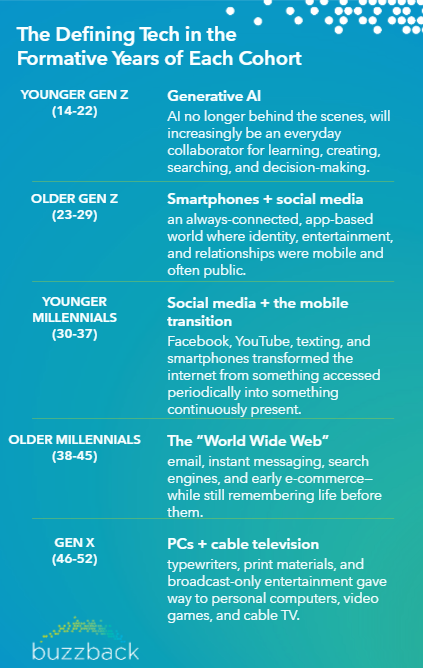
Gen Z is coming of age amidst what is already known as a transformational general purpose technology. "General-purpose technology" (abbreviated "GPT" like a popular AI-platform most of us know!) is the category economists reserve for technologies that have the power to revolutionize societies, like electricity, the steam engine, and the Internet. Gen-AI isn't just changing what Gen Z does — it is and will continue to change how they learn, decide, create, and build confidence.
Around three-quarters of Gen Z across the markets and cohorts in our research use AI at least occasionally, with regular use already reaching 38–46% among younger Gen Z and 51% among older Gen Z.
Among Gen Z who use AI, the breadth of application matters: 51% turn to it for quick answers or explanations, 43% use it to learn about or research new topics, and 36% use it to brainstorm or create content. Others use it to analyze information, organize work or life, automate tasks, reflect on personal challenges, or seek health and wellbeing guidance.
Gen Z is not forming one generic relationship with AI. They are choosing among multiple relationships, each defined by the job they want AI to perform — and those relationships can be understood through three archetypes.
The Clerk
Helping someone complete a task, save time, or get a quick answer efficiently.
The Collaborator
Helping them explore ideas, compare options, and improve what they are creating.
The Coach
Supporting reflection, personal development, and better judgment over time.
The archetype is not fixed by age or stage of adoption. People choose the role that fits what they need in that moment. This is especially visible in decision-making: 40% say AI helps them compare options, 35% say it introduces brands or products they might not have searched for, 35% use it to narrow their choices, and 31% say it makes decisions faster or more efficient.
What this means for brands
If technology is becoming part of how Gen Z copes, connects, creates, and decides, then adding another feature, notification, feed, or AI function is not enough. It points to a broader agenda:
- 1 Design around the human job. Start with the state Gen Z is trying to reach: relief, connection, agency, confidence, or control. Learn directly from Gen Z about the need behind the behavior.
- 2 Reduce pressure and respect attention. Remove avoidable noise, interruptions, and endless demands for engagement. Make it easy to pause, leave, return, and control the pace of the experience.
- 3 Build agency and make progress visible. Borrow from gaming's most transferable strengths: quick wins, meaningful feedback, participation, optional depth, and rewards for sustained engagement without demanding constant attention.
- 4 Choose the AI archetype intentionally. Decide whether the job calls for a Clerk, a Collaborator, a Coach, or no AI at all. The right role depends on the need in the moment, not the user's age.
- 5 Keep people in control of decisions. Use AI to organize complexity, surface tradeoffs, compare options, and narrow the field — while keeping final judgment visibly with the person.
- 6 Compete for discovery, not only preference. AI is becoming an audience as well as an interface. Give AI systems clear, current, specific, and well-structured brand information, reinforced by credible third-party sources, so the brand can enter a fluid consideration set.
- 7 Earn trust through privacy, transparency, and control. Privacy protection is the leading signal of a responsible technology brand (51%), followed by clarity about data and content use (48%), transparency about AI (40%), and avoiding manipulative design (37%). Move these commitments out of the fine print and into the experience.
- 8 Keep evolving, and improve what people already depend on. Innovation earns relevance when it makes the core experience more useful and reliable. Rushed or gimmicky AI layered over a deteriorating product does the opposite.
About this research
buzzback Gen Z & Technology Research
This article draws on buzzback's proprietary US and UK research into Gen Z's relationship with technology, stress, and digital wellbeing — spanning ages 14–29 and including younger Millennials for generational context. Interested in exploring what this means for your brand or category? We'd welcome the conversation.